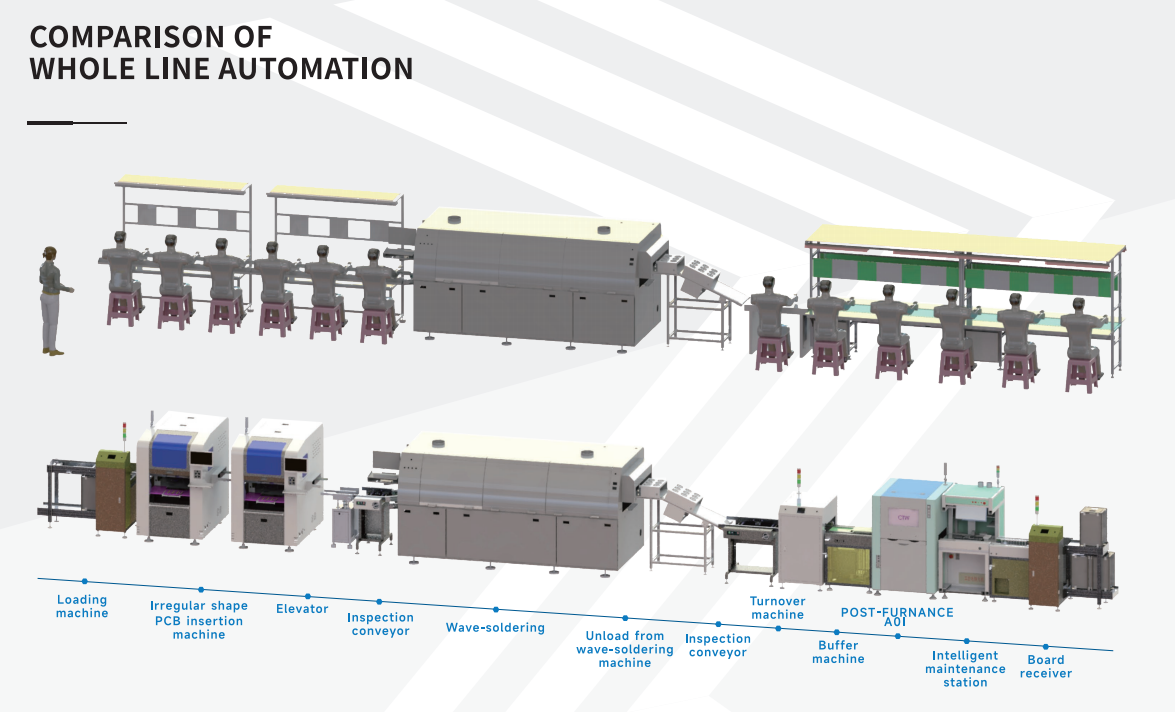
In the rapidly evolving electronics manufacturing industry, automated production equipment has become a core driver for enhancing efficiency and quality. It not only helps enterprises stay competitive but also lays a solid foundation for future smart manufacturing.
In the rapidly evolving electronics manufacturing industry, automated production equipment has become a core driver for enhancing efficiency and quality. It not only helps enterprises stay competitive but also lays a solid foundation for future smart manufacturing.
High Efficiency
Automated equipment can complete massive assembly tasks in a short time, delivering production efficiency far beyond manual operations. It significantly shortens lead times and enables rapid responses to market demands.
Precision & Stability
With advanced visual positioning and servo control systems, automated equipment ensures precise component placement, greatly reducing defects and guaranteeing product consistency and reliability.
Cost Optimization
Automation reduces reliance on manual labor, lowering labor and management costs. The saved resources can be reinvested in R&D and market expansion, enhancing overall operational efficiency.
Flexible Manufacturing
Supporting fast changeovers and multi-variety production, automated equipment easily adapts to small-batch and multi-spec orders. It helps enterprises build flexible production lines and avoid capacity bottlenecks.
Safe & Labor-Saving
Automated equipment can operate reliably in high-intensity or harsh environments, handling heavy and repetitive tasks. This reduces physical strain, improves safety, and enhances employee satisfaction.
End-to-End Quality Control
Equipped with in-line inspection and data traceability systems, automated equipment enables real-time quality monitoring. It lowers defect rates, improves yields, and builds a strong foundation for quality competitiveness.